How to choose the best employee engagement software for your team

Choosing employee engagement software sounds simple enough, until you start looking.
Some tools measure how employees feel. Others focus on recognition and rewards. Some help you communicate with dispersed teams, while others bring perks, wellbeing, recognition and company updates together in one place.
They can all sit under the broad label of employee engagement tools, but they don't necessarily solve the same problem.
So, rather than starting with a list of providers, it helps to start with your people. What would make the biggest difference to their experience at work? And what does your HR team need to make that happen?
In this guide, we'll look at the main types of employee engagement software, how they compare and what to consider before choosing an employee engagement system for your organisation.
If you want to understand how an all-in-one platform works first, take a look at our employee engagement platform.
Employee engagement software is technology designed to help organisations understand, support or improve the relationship employees have with their workplace.
That's quite a broad definition, which is why two employee engagement systems can look completely different.
One might focus on employee surveys and give HR teams detailed engagement scores. Another might give employees a central place to access perks, recognise their colleagues, use wellbeing support and keep up with company news.
The important distinction is between measuring engagement and creating it.
Survey and analytics tools are largely designed to tell you how your people feel. Other employee engagement tools give employees something to actively use, helping organisations turn engagement initiatives into part of everyday working life.
Neither approach is automatically better. It depends on the problem you're trying to solve.
Most employee engagement software falls into four broad categories. Understanding the difference between them makes an employee engagement platform comparison much more useful than simply comparing feature lists.
Employee survey and analytics tools are built primarily to measure engagement.
They can help HR teams run pulse surveys, gather employee feedback, monitor engagement scores and identify trends across departments, locations or demographic groups.
This makes them particularly useful when your main challenge is visibility. If you don't know how employees feel, where engagement is dropping or what's driving dissatisfaction, better data can give you somewhere to start.
The trade-off is that measuring engagement doesn't necessarily improve it. Once you've identified a problem, you'll still need a way to act on what you've learned.
Organisations that already have engagement initiatives in place but need better insight into how employees feel.
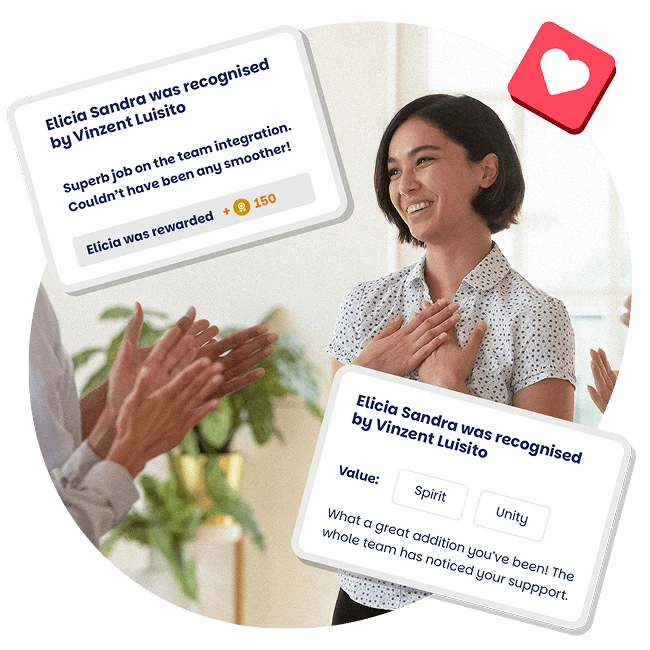
Recognition and reward software makes it easier for employees and managers to celebrate great work.
That might include peer-to-peer recognition, manager recognition, points-based rewards, company-value awards and automated celebrations for birthdays or work anniversaries.
These tools can be a good fit when employees aren't receiving enough recognition, or when appreciation is inconsistent across different teams and managers. They can also help organisations make company values more visible by connecting recognition to the behaviours they want to encourage.
If recognition is your main priority, explore what to look for in an employee recognition and reward platform.
Organisations that want to build a stronger culture of appreciation and make recognition more consistent.
Sometimes engagement problems are communication problems.
Employees may feel disconnected because they don't know what's happening elsewhere in the organisation, important announcements don't reach everyone, or deskless workers are left out of communication designed around email and intranets.
An internal communications employee engagement tool can provide a central place for company news, updates, resources and announcements.
This can be particularly valuable for organisations with frontline, deskless, remote or multi-site workforces, where reaching everyone consistently isn't always easy.
Organisations where keeping employees informed and connected is the biggest challenge.
An all-in-one platform brings several parts of the employee experience together.
Rather than asking employees to use one system for recognition, another for perks and another for wellbeing, these platforms create a single employee engagement portal or app where people can access different forms of support.
Depending on the platform, that could include employee discounts and perks, recognition and rewards, wellbeing support and company communication.
The advantage is that engagement doesn't depend on employees remembering to visit a tool solely when HR asks them to. If there are useful reasons to come back regularly, whether that's saving money or recognising a colleague, the platform has more opportunities to become part of everyday working life.
This is the category Perkbox sits within. Our employee engagement platform combines perks, benefits, recognition, wellbeing and culture tools in one app.
Organisations looking for a broader way to support engagement across multiple parts of the employee experience.
The best employee engagement software isn't necessarily the one with the most features. It's the one that best matches what you're trying to change.
| If your main challenge is... | Consider... | What it helps with |
|---|---|---|
| You don't know how employees feel | Survey and analytics software | Feedback, sentiment and engagement measurement |
| Employees don't feel appreciated | Recognition and reward software | Peer recognition, manager recognition and rewards |
| People are missing important updates | Internal communications software | Company news, communication and employee reach |
| Engagement feels fragmented across different initiatives | All-in-one benefits and engagement software | Bringing perks, recognition, wellbeing and culture together |
There can be overlap between these categories, of course. An all-in-one platform might include polls or feedback tools, while a recognition platform may include communication features.
That's why it's worth looking beyond how a product describes itself and asking a more useful question: what will our employees actually be able to do with it?
That tends to reveal much more than a long feature list.
Once you've worked out which type of system you need, you can start comparing the details.
There's no universal checklist that every business should follow, but there are some areas worth thinking about.
If people have to remember another password, visit a complicated portal or jump between different systems, you're creating barriers before they've even started. Look at the experience from an employee's point of view, not just the admin dashboard.
If appreciation is part of your engagement strategy, look at how easy it is for peers and managers to recognise somebody and whether rewards can be added when appropriate.
Everyday value can give employees another reason to engage with the platform regularly. That could include employee discounts, perks and benefits that help their salary go further.
Consider whether the system can support employees' mental, physical and financial wellbeing and, importantly, how easy that support is to access when they need it.
If you have remote, deskless or multi-site teams, think about how announcements and resources reach people without relying on a company inbox.
Your employee engagement system shouldn't create a mountain of admin. Integration with HR and payroll systems can help automate joiners and leavers and keep employee data up to date.
Look beyond whether reporting exists and ask what you'll actually learn from it. Can you see activation? Which parts of the platform do people use? Is recognition happening across different teams? Useful reporting should help you make decisions, rather than simply give you more dashboards.
This is where it's tempting to search for the best employee engagement platforms and choose from whichever names appear most often.
But what's right for another organisation may be completely wrong for yours.
A 150-person business with a hybrid workforce has different requirements from a retailer with thousands of frontline employees. Likewise, an organisation struggling with recognition needs something different from one that already has a strong culture but lacks insight into employee sentiment.
So before booking demos, get clear on a few things.
What are you actually trying to improve?
Maybe employee recognition is inconsistent. Perhaps your benefits aren't being used. You could be struggling to communicate with deskless teams, or employees might simply feel disconnected from the wider organisation.
Write those problems down before looking at products.
It becomes much easier to assess an employee engagement system when you can ask, “Will this help us solve X?” rather than “Does this have lots of features?”
HR might buy the software, but employees have to use it.
Ask people what would genuinely make their working experience better. That could uncover priorities you hadn't considered, or tell you that something you assumed mattered actually doesn't.
This can also help with adoption later. When employees can see that a new platform responds to something they've asked for, it feels less like another HR initiative that's been handed down to them.
One of the biggest questions to ask during an employee engagement platform comparison is: why would an employee open this tomorrow? And next month?
A platform may look impressive during a demo, but long-term value comes from employees continuing to use it after launch.
Look for features with genuine everyday relevance, whether that's accessing a discount, recognising a colleague, checking an update or finding wellbeing support.
A tool that's engaging for employees but painful for HR isn't much of a solution.
Ask what happens when somebody joins or leaves, how employee data is updated, how rewards are managed and how much manual work sits behind regular communications.
Good integrations and automation can make a big difference, particularly as your organisation grows.
It can be useful to map what employees already have access to.
You may discover that you're already paying for separate perks, wellbeing, communication and recognition tools. If employees need several logins to access them, bringing some of those experiences together could make things simpler for employees as well as HR.
On the other hand, if you already have excellent systems in three areas and only recognition is missing, a specialist recognition tool could make more sense.
You don't need an all-in-one platform just because one exists, but it can make things more straightforward.
There's no single best employee engagement platform in the UK for every organisation because businesses aren't all trying to solve the same engagement problem.
For some employers, the right choice will be a survey platform because understanding employee sentiment is the priority. Others may get more value from dedicated recognition software or a communication tool built around a large deskless workforce.
For organisations looking to connect several parts of the employee experience, an all-in-one engagement platform can make more sense. This approach can bring benefits, recognition, wellbeing and company communication together rather than asking employees to engage with several disconnected systems.
So when comparing the best employee engagement platforms UK businesses can choose from, start with fit rather than rankings. The strongest option is the one your employees are likely to use, and your HR team can realistically manage.
How and where your employees work can have just as much impact on your choice as company size.
A system designed around employees sitting at a laptop all day isn't necessarily going to work for a workforce spread across shops, factories or healthcare sites.

For deskless employees, accessibility should be at the top of your list.
If people don't have company email addresses or regular access to a desktop, engagement can't depend on an intranet they rarely see.
Look for mobile-friendly access and simple onboarding that lets employees connect wherever they work. Communication and recognition can be particularly important here because informal office interactions aren't available to everyone.
Remote and hybrid working can make it harder for employees to feel connected to colleagues and company culture.
Employee engagement tools can help create shared experiences across locations through peer recognition, company updates, rewards and wellbeing initiatives.
The goal isn't to recreate the office digitally. It's to make sure where somebody works doesn't determine whether they feel included.
For a growing business, simplicity matters.
You may not have a large People team with time to administer several different employee engagement systems. Look at how much ongoing work a platform creates, how pricing changes as headcount grows and whether you can add capabilities as your needs develop.
An all-in-one approach can be particularly useful if you're starting to formalise benefits, recognition and wellbeing at the same time. But if you only have one clear engagement gap, a focused tool may be all you need.
Larger organisations tend to need more from integrations, administration and reporting.
It's worth considering whether the platform can handle different teams and locations while still giving employees a consistent experience.
You may also need to look more closely at HR system integration, user management, reporting and how easily communications or recognition can be targeted to particular employee groups.
Employee engagement software pricing varies depending on the type of system, the size of your workforce and what you want it to do.
Some providers charge per employee per month, while others use annual licences, packages or bespoke enterprise pricing. An all-in-one platform may also let you choose which modules you need rather than paying for everything from day one.
When comparing costs, look beyond the headline figure. Implementation, integrations, account support and optional features can all affect the overall price.
It's also worth considering whether you're replacing anything. A platform that consolidates several existing employee engagement tools may cost more than one standalone product while reducing what you're spending elsewhere.
Most importantly, compare like with like. A survey platform and an all-in-one engagement system may both be described as employee engagement software, but you're paying them to do very different things.
For more detail on Perkbox’s pricing, get a tailored quote from our team today.
A demo is your chance to see past the feature list.
Rather than asking the provider to run through everything the software can do, give them scenarios that reflect your workforce. Ask them to show you exactly how an employee would recognise a colleague, find a benefit, access support, or read an important company update.
It’s also worth asking:
And ask to see the employee experience, not just the HR dashboard. A beautiful reporting interface isn't much consolation if employees find the actual platform difficult to use.
By the time you start comparing options, you should have a fairly clear picture of what you need.
Create a shortlist of requirements and separate them into must-haves and nice-to-haves. Then assess each option against the same criteria.
Think about the problem it solves, employee experience, ease of administration, integrations, accessibility, likely adoption, reporting and total cost.
This gives you a much more meaningful employee engagement platform comparison than simply counting features.
And remember that choosing the biggest system isn't the goal. Choosing something people will actually use is.
Perkbox is an all-in-one employee engagement platform, bringing perks and discounts, benefits, recognition, wellbeing support and culture tools together in one app.
That means it's designed for organisations that want to improve several parts of the employee experience rather than solve one isolated engagement challenge.
More than 7,500 businesses use Perkbox to support over four million employees worldwide. Employees can access thousands of perks and discounts, recognise their colleagues, celebrate achievements, use wellbeing support and keep connected with their organisation from one place.
If your priority is purely employee sentiment measurement, a dedicated survey and analytics tool may be a better fit. If your main challenge is specialist internal communications, a dedicated communications platform may give you greater depth.
But if you're looking to bring everyday value, recognition, wellbeing and culture together, Perkbox could be the answer. Explore our employee engagement platform here.



Share